At the end of our specialty training, which gave us an MOS (Military Occupational Specialty) dabbling in secret, Keystone Cop-like operations, we were visited by a colorless man in a gray suit, who, one by one, took us into a closed room to tell us our fate. He introduced himself as Mr. somebody or other, which I came to feel afterwards wasn’t his real name to begin with.
As I sat down across from him, he informed me that I was going to be sent to Berlin Germany to the US Army Europe Security Detachment. I would not tell anyone that I was an MI officer, and that my orders would show me as being in the Quartermaster Corps. I responded to this by asking why not just send me as being infantry, since I already legitimately had the ribbons and badges that proclaimed me as such. Besides, if anyone asked why a grunt was going to a “spook” unit, I could just shrug my shoulders and say, “You know the army.” He agreed.
He then gave me a name, also fictitious, of someone in Virginia for my parents to contact in case of emergency because the Red Cross would not know my whereabouts. My name would not be on the register of the US Army. I was nobody. Furthermore, when I arrived in Frankfurt, I would be met by someone and not go to the replacement depot. I felt like Scrooge being told I would be visited by spirits.
We were cramped aboard a Trans Caribbean Airlines 707 headed to Germany when the career E-7 beside me asked where I was going. His question to my response was as I had predicted, “What are you doing going to a spook unit.” My pre-planned answer set everything right.
Upon landing in Frankfurt, we dragged our duffle bags down the corridor following signs pointing us to the replacement depot, when two young men in civilian clothes stepped forward, and said, “Captain Millar, please come with us.” The E-7’s jaw dropped, and we said good-bye.
Without introducing themselves, and obviously not enthusiastic about working on a Sunday, they took me outside to a van, and drove to a nondescript apartment building, where I was instructed to change into civilian clothes, and spend the rest of the day the way I wanted. I conned 5 DM, about $1.50, off them and walked around until 5 PM, when they collected me for a trip to the train station to board the 7 o’clock duty train for Berlin.
The duty train had been created by the agreements between the Soviet Union, England and the US at the end of the WWII, and was allowed to pass through East Germany unmolested by either the Russians or the East Germans. It was the only way, I found, that I would be allowed to leave West Berlin, unless I chose to fly.
While I was hanging out, waiting for the train to leave, along with a multitude of uniformed Americans, a somewhat scruffy but unremarkable young man approached me and asked if I spoke English. I told him I did. He began to regale me with the classic story I had heard from many deadbeat hippies when I was a student. “I’m going to school here and my father has just had a heart attack. I need five marks to get out to the airport.” Not wanting to give him anything, I reached into my pocket and pulled out a US quarter, guaranteed to not get him on the bus. “That’s all I have,” I said. In a flash, he grabbed it, held it up in front of me and palmed it. “I’ve gotten everything I need,” he said, “Believe me, you don’t know how much I dislike doing this.” And then he disappeared into the crowd.
Short a quarter I boarded the train and forgot about it.
Several months later, in Berlin, I was in the parking lot of the US Consulate, where our unit was stationed. As I was entering my duty car, this same person approached me with the same story. “I’m a student here, and my father’s just had a heart attack. I need $2 to get to Tempelhof Airport.” I stared at him a moment and replied, “That’s funny, in Frankfurt it was 5 marks to get to the airport.”
With that he blanched. “You know me,” he said. “I do, and if I see your ass around here again, I’m turning you over to the MPs.” Several weeks later I saw him again, headed straight for him, and when he saw me, he disappeared at a dead run.
I’ve often been told that you’re not paranoid if they really are following you, but when I returned to the States, living with my ex-wife and attending graduate school, the local police chief, to whom she had been recommended as a possible school crossing guard came to the trailer one night to talk to her. Caught up in his own importance, he told us how he had driven by, done a license plate check, and realizing that I was 26 years old, ascertained I was probably a veteran and contacted the Army’s counter-intelligence office in Portsmouth, NH. “I should have gone there first,” he said to my wife. “They not only had everything on him, they had a whole file on you.”
At that point I turned to him and said, “That’s really odd…… We weren’t married until after I was discharged.” His face revealed he had talked too much.
I’ve often wondered who that young man was. The coincidence of him hitting me up in two cities, particularly in an area of Berlin where tourists didn’t hang out, was pretty far fetched. That leads to question, then, of what was he doing? Several former intelligence people to whom I have related this story believe he was working for another of our agencies. And why me? I’ll probably never know.
Showing posts with label UNH. Show all posts
Showing posts with label UNH. Show all posts
Saturday, April 18, 2009

Monday, February 2, 2009
For Don Murray
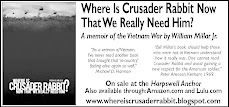
In 1977 I had finished the draft of Where is Crusader Rabbitt, Now That We Really Need Him? typed out on the backs of old quizzes I had scrounged from the waste bins at York High School in York, ME. From the time I had started it in 1973, I had gone from being poor, single and living in the slum of Portsmouth, NH (Those of you familiar with Portsmouth might remember Seacrest Village) to being married to a wonderful lady who was a nursing instructor on the faculty of the University of New Hampshire.
One of her extra duties was to represent her department on the Faculty Senate. Among her fellow “senators” was Don Murray, perhaps one of the most popular faculty members who ever walked the halls of UNH.
Don had dropped out of high school to work in a logging camp, and at the outset of WWII had enlisted as a paratrooper and served throughout the war with the 82nd Airborne Division. Upon being discharged, he returned to school on the GI Bill, received a BA and MA, and also won the Pulitzer Prize.
At one meeting, Susan told him about my project, and he replied that he would like to see it. So at the next meeting, she presented him a ratty assortment of various colored paper bound up in four term paper folders. Not long afterward I received a call, asking if I could come over to his office some afternoon after I was done teaching, an invitation I accepted with some trepidation, considering the stature of a man like Don Murray.
We spent a pleasant afternoon, during which he waved off a stream of visitors, sharing stories about living in the mud and eating out of tin cans. Then he cut to the chase and asked what I planned on doing with the manuscript. My response was that I was happy I had written something that long, when no one else I knew had. And besides, trying to get something published was shooting in the dark.
He leaned forward, looked me square in the eye and asked, “Tell me, do you like sex, or do you like to masturbate?” I responded that after years of being single, the former was my preference, or words to that effect. “Well,” he said, “If you don’t try to publish this, you’re just masturbating.”
Well, I’m slow, but it’s finally been done. I only wish he were still around to see it. I quit when I needed glasses.
One of her extra duties was to represent her department on the Faculty Senate. Among her fellow “senators” was Don Murray, perhaps one of the most popular faculty members who ever walked the halls of UNH.
Don had dropped out of high school to work in a logging camp, and at the outset of WWII had enlisted as a paratrooper and served throughout the war with the 82nd Airborne Division. Upon being discharged, he returned to school on the GI Bill, received a BA and MA, and also won the Pulitzer Prize.
At one meeting, Susan told him about my project, and he replied that he would like to see it. So at the next meeting, she presented him a ratty assortment of various colored paper bound up in four term paper folders. Not long afterward I received a call, asking if I could come over to his office some afternoon after I was done teaching, an invitation I accepted with some trepidation, considering the stature of a man like Don Murray.
We spent a pleasant afternoon, during which he waved off a stream of visitors, sharing stories about living in the mud and eating out of tin cans. Then he cut to the chase and asked what I planned on doing with the manuscript. My response was that I was happy I had written something that long, when no one else I knew had. And besides, trying to get something published was shooting in the dark.
He leaned forward, looked me square in the eye and asked, “Tell me, do you like sex, or do you like to masturbate?” I responded that after years of being single, the former was my preference, or words to that effect. “Well,” he said, “If you don’t try to publish this, you’re just masturbating.”
Well, I’m slow, but it’s finally been done. I only wish he were still around to see it. I quit when I needed glasses.
Wednesday, January 28, 2009
It Wasn't Always Protested
The popular conception of the war in Vietnam, is that it was widely opposed from the start. What is forgotten is that, at least in Northern New England, the majority of the people, and even college students either supported the effort, or were at least silent in their opposition.
I can call to mind two events, long forgotten probably by even those who were present at the time. It was during my sophomore year at the University of New Hampshire (1965-1966). At that time, some of the more hard-hearted professors would admonish the class to study harder by warning them of the consequences of failure, which meant getting drafted. During my freshman year, an acquaintance of mine from the class ahead of me, failed to heed this warning, and to avoid being drafted, enlisted in the Army to become a paratrooper. He shortly found himself serving with the 101st Airborne Division in Vietnam, where his young life was tragically cut short. The university newspaper ran a rather lengthy story about him, quoting some of his letters home, and there was a general sympathy for the sacrifice he had made, even among some of the more pacifistic students.
How different that time from when I was ordered overseas in 1969, when a former college friend, in responding to a letter I had written telling him of my news wrote, “If you get killed or wounded, you’re only getting what’s coming to you.”
When spring brought the UNH campus out of its winter cocoon in 1966, word spread that a group of Quakers planned to hold a peace vigil in the Memorial Room of the student union, the Memorial Union Building, commonly called the “MUB.” The Memorial Room had a wall sized plaque with the names of UNH alumni, who had died in service during our past wars. Ironically the class of 1942, my father’s class, had the largest number of names from WWII, as 1968, my class, was to have in Vietnam.
The group proposed to walk from a silent vigil they would hold at the front gate of Pease AFB in Newington, NH to the Durham Campus and do the same when they arrived at the MUB.
Word quickly spread across the campus, and soon a large crowd, mostly male as I remember, gathered in front of the MUB, a few carrying American flags, to wait the arrival of the “Peaceniks,” and deny their entry. There was a strong feeling that to hold an anti-war vigil would desecrate the purpose of the Memorial Room. Rumors would spread through the crowd like a zephyr rippling across water as to the progress of the marchers. As I remember, some of the information was being relayed along by the police, as the local law enforcement agencies appeared to be in sympathy with the crowd. Had any violence been acted towards, the protestors that day, I doubt to this day that they would have received a lot of protection.
At last word arrived that they were at the outskirts of town, and people strained to see them coming. Unlike what anyone probably expected, the group consisted of about a dozen people, dressed in black, most of them older than we. As they walked quietly up the sidewalk on Main St., not a few of them looked terrified. The crowd, shouted, jeered, and probably a few water balloons or empty beer cans may have been tossed. From where I stood, off to the side, I could not tell if they said anything, but they did appear to pray.
My own feeling at the time was I thought it inappropriate to hold a peace vigil in a room honoring war dead, but the other half of me felt it was their right to do so whether I agreed with it or not.
After a few moments, the group decided not to try to enter, walked away and everyone went to the dining hall for supper.
I went to Germany that fall to study, and when I returned in 1967, the “Ballad of the Green Berets” and “Billy, Don’t Be A Hero,” had disappeared from the radio, and the crowd on the lawn of the MUB had now forgotten what they had done, that spring day in 1966.
I can call to mind two events, long forgotten probably by even those who were present at the time. It was during my sophomore year at the University of New Hampshire (1965-1966). At that time, some of the more hard-hearted professors would admonish the class to study harder by warning them of the consequences of failure, which meant getting drafted. During my freshman year, an acquaintance of mine from the class ahead of me, failed to heed this warning, and to avoid being drafted, enlisted in the Army to become a paratrooper. He shortly found himself serving with the 101st Airborne Division in Vietnam, where his young life was tragically cut short. The university newspaper ran a rather lengthy story about him, quoting some of his letters home, and there was a general sympathy for the sacrifice he had made, even among some of the more pacifistic students.
How different that time from when I was ordered overseas in 1969, when a former college friend, in responding to a letter I had written telling him of my news wrote, “If you get killed or wounded, you’re only getting what’s coming to you.”
When spring brought the UNH campus out of its winter cocoon in 1966, word spread that a group of Quakers planned to hold a peace vigil in the Memorial Room of the student union, the Memorial Union Building, commonly called the “MUB.” The Memorial Room had a wall sized plaque with the names of UNH alumni, who had died in service during our past wars. Ironically the class of 1942, my father’s class, had the largest number of names from WWII, as 1968, my class, was to have in Vietnam.
The group proposed to walk from a silent vigil they would hold at the front gate of Pease AFB in Newington, NH to the Durham Campus and do the same when they arrived at the MUB.
Word quickly spread across the campus, and soon a large crowd, mostly male as I remember, gathered in front of the MUB, a few carrying American flags, to wait the arrival of the “Peaceniks,” and deny their entry. There was a strong feeling that to hold an anti-war vigil would desecrate the purpose of the Memorial Room. Rumors would spread through the crowd like a zephyr rippling across water as to the progress of the marchers. As I remember, some of the information was being relayed along by the police, as the local law enforcement agencies appeared to be in sympathy with the crowd. Had any violence been acted towards, the protestors that day, I doubt to this day that they would have received a lot of protection.
At last word arrived that they were at the outskirts of town, and people strained to see them coming. Unlike what anyone probably expected, the group consisted of about a dozen people, dressed in black, most of them older than we. As they walked quietly up the sidewalk on Main St., not a few of them looked terrified. The crowd, shouted, jeered, and probably a few water balloons or empty beer cans may have been tossed. From where I stood, off to the side, I could not tell if they said anything, but they did appear to pray.
My own feeling at the time was I thought it inappropriate to hold a peace vigil in a room honoring war dead, but the other half of me felt it was their right to do so whether I agreed with it or not.
After a few moments, the group decided not to try to enter, walked away and everyone went to the dining hall for supper.
I went to Germany that fall to study, and when I returned in 1967, the “Ballad of the Green Berets” and “Billy, Don’t Be A Hero,” had disappeared from the radio, and the crowd on the lawn of the MUB had now forgotten what they had done, that spring day in 1966.
Subscribe to:
Posts (Atom)